OCR
3 Things, etc
3 Things, etc
They’re seeing that AI adoption is accelerating far faster than governance, oversight, or policy can keep up, creating blind spots that expose organisations to operational, legal, and reputational harm. At the same time, they recognise that most incident response plans have never been tested under the speed, pressure and the unpredictability of a real crisis, especially one amplified by AI‑driven attacks or modern ransomware tactics.
In our three‑part series, we asked one of the UK’s leading cyber security specialists, Core to Cloud, to break down the most critical issues facing businesses today. Their insights highlight why AI risk management, ransomware resilience, and realistic crisis simulation should now be embedded into every company's business procedures, not as optional exercises, but as essential components of operational continuity and leadership accountability.
Our 3-Part series reflects how Boards, regulators and insurers are increasingly demanding that businesses prove control, rather than simply assert it.

How to demonstrate real security maturity: Discover how to move beyond high‑level assurances and show tangible, operational proof of control -something boards, insurers, and regulators increasingly expect.
How to express security in business-ready terms: Learn how to translate technical security activity into operational performance indicators that resonate with senior stakeholders and withstand scrutiny.
How to evidence your organisation’s ability to prevent, resist, and respond: Gain apractical framework for demonstrating that your environment can withstand attacks and recover effectively, backed by measurable operational data.
How to shift from “trust me” to “trust the evidence”: See how to replace subjective confidence with objective, repeatable, defensible proof of security capability by reducing risk, strengthening credibility, and improving decision-making.
How to protect both the business and your own leadership position: Demonstrate how to show that your security programme is not only functioning, but accountable, transparent, and aligned with stakeholder expectations—positioning you as a proactive, evidence‑driven leader.
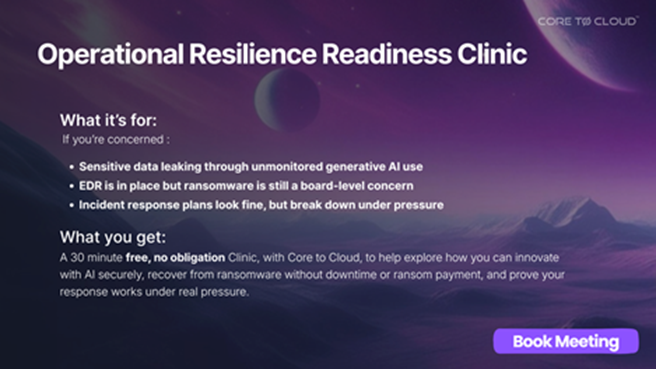
This series is featured in our community because it reflects conversations increasingly happening among senior security and risk leaders.
Much of the industry focuses on tools and threats with far less attention given to how confidence is formed, tested, and sustained under scrutiny. The perspective explored here addresses that gap without promoting solutions or prescribing action.
Core to Cloud is referenced because its work centres on operational reality rather than maturity claims. Their focus on decision-making, evidence, and validation aligns with the purpose of this publication: helping leaders ask better questions before pressure forces answers.

But it’s also creating a new kind of data risk.

Pressure test it with Crisis Simulation

Framing ransomware as a technical problem misses what makes it so damaging.
Share this story
Let us know what you think about the article.