Operational Cyber Resilience
What’s most important to your organisation's security in 2026?
What’s most important to your organisation's security in 2026?
Manual risk assessments are time-consuming, quickly outdated, and often incomplete, making it harder to meet compliance and protect your digital perimeter.
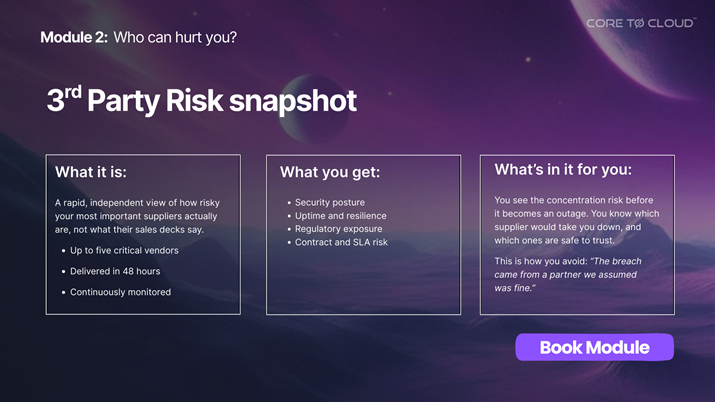
Cyber criminals increasingly exploit third-party weaknesses. Without constant oversight, these gaps can lead to breaches, operational disruption, or regulatory fines. A static snapshot isn’t
enough, organisations need ongoing visibility and expert action.
These resources from Core to Cloud delve into how you can improve your operational cyber resilience.
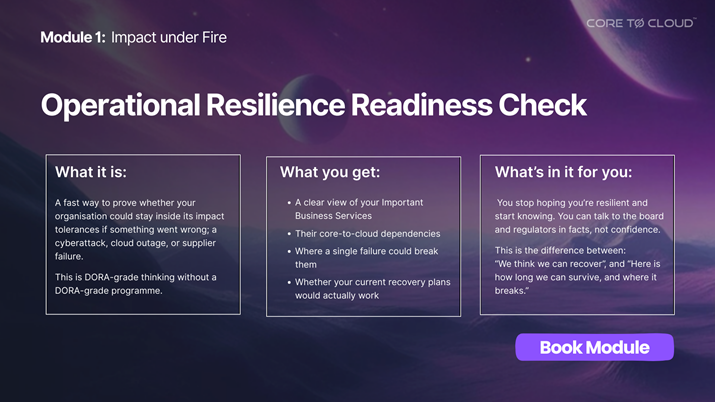
Know what would fail, before it does.
A practical, evidence-based way for security leaders to test whether their cyber security environment would actually survive a real incident, not just look good on paper. It's not a maturity model, or a vendor pitch.
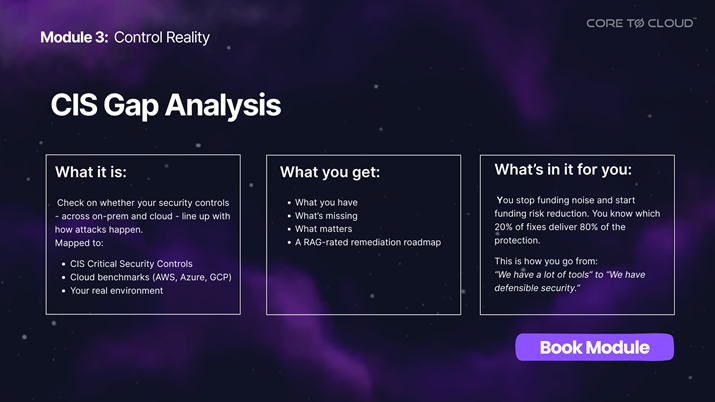
A set of three targeted control checks that answer the questions boards, regulators and CISOs are now being judged on.
You don’t “buy” the Control Room. You enter it. Each module is a stand-alone, low-friction diagnostic that gives you something immediately useful, even if you do nothing else.
You can do one; most teams end up doing two. High-risk environments do all three.
Most programmes start with:
The Cyber Resilience Control Room starts with:
You don’t need a big programme to get value. Pick the one that matches where you’re most exposed right now:
This series is featured in our community because it reflects conversations increasingly happening among senior security and risk leaders.
Much of the industry focuses on tools and threats with far less attention given to how confidence is formed, tested, and sustained under scrutiny. The perspective explored here addresses that gap without promoting solutions or prescribing action.
Core to Cloud is referenced because its work centres on operational reality rather than maturity claims. Their focus on decision-making, evidence, and validation aligns with the purpose of this publication: helping leaders ask better questions before pressure forces answers.

Validating cyber resilience before it’s tested for you

Why assumed strength breaks under scrutiny

What insurers, regulators, and boards expect after an incident

What cyber readiness should look like from inside the business

The gap between decision and decisive action

Why security incidents are shaped more by people than technology

Control, confidence, and accountability without slowing down business

AI moves data in ways your controls can't see

How ransomware keeps hurting long after cleanup

Assumptions, dependencies, and uncomfortable timelines after a cyber incident

What matters is that your business still runs

Why security issues escalate faster than most leadership teams expect
Share this story

Let us know what you think about the article.