Week 9
Subtitle here
Subtitle here
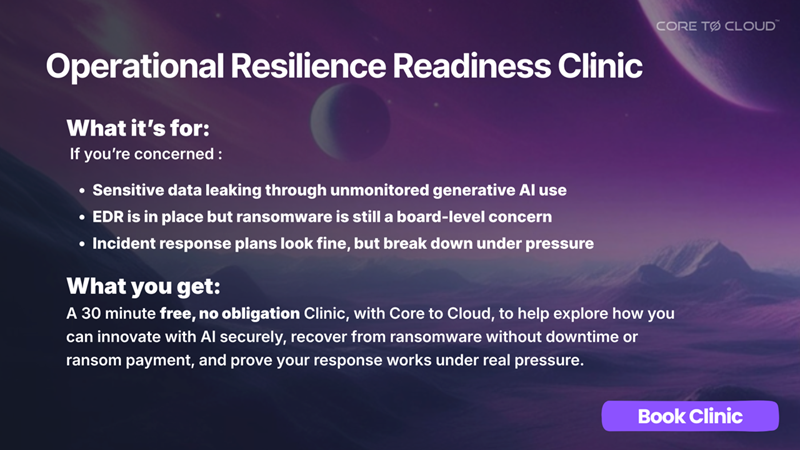
Across organisations, controls and tooling have improved dramatically. Despite significant investment in detection, identity, endpoint, and resilience, when incidents happen the true danger lies in the decisions made in the first few hours. If escalation processes break down, decision rights become ambiguous, and communication can rapidly become disintegrated as teams work at speed for the first time in a live environment.
This is why crisis simulation is so important for leaders who are increasingly under scrutiny as it offers a clear and defensible view of readiness before an actual incident puts it to the test. We bring you Core to Cloud’s Crisis Simulation service for you to review where the emphasis is on how your organisation responds as a system, rather than simply how your technology works.
This brings IT, security, legal, communications, finance, and executive leadership together in realistic, time-pressured scenarios to observe how well they work together in practice. The scenarios are developed around real-world events and offer structured analysis of where response capability is strong and where it needs to be improved. See what a crisis simulation uncovers in practice.
Here's how to request your no-cost sample report.
Let us know what you think about the article.