Good breach response 'on paper'?
Pressure test it with Crisis Simulation
Pressure test it with Crisis Simulation
They go wrong because the first few hours of a real event are messy. Information is incomplete, teams are working at speed, and decisions that feel straightforward on paper become difficult in practice.
In that moment, even strong technical defences can be undermined by slow escalation, unclear ownership, and communication that does not land when it needs to. Core to Cloud’s Crisis Simulation service exists to tackle that reality by testing how your organisation responds under pressure, before a real incident forces that test on you.

The underlying cause is usually the same. Most organisations have some form of incident response documentation, but far fewer have a response capability that has been properly rehearsed across the business. The gap between intent and readiness is well known.
Cyberattacks are widely understood to be a matter of “if” rather than “when,” yet formal preparation often lags behind the level of threat. Even when cybersecurity is treated as a board priority, many organisations still lack a formal incident response plan, and that lack of structure becomes painfully visible when ransomware, DDoS attacks, or supply chain compromises hit at speed.
Another core problem is that incidents are not only technical. In a real breach, IT may be leading containment and recovery, but they are rarely the only team shaping the outcome. Legal is assessing disclosure thresholds, contractual obligations, and regulatory exposure.
In a real breach, IT may be leading containment and recovery, but they are rarely the only team shaping the outcome.
Communications and PR are managing reputational impact and message discipline. Finance is evaluating operational disruption and cost. HR may need to support internal communications, staff guidance, and insider-risk considerations. Customer-facing teams are fielding questions and managing trust in real time.
Risk and compliance are thinking about audit evidence and policy alignment. Leadership and executives are often the ones asked to make the highest-impact decisions quickly: when to engage external support, whether systems can be taken offline, what gets prioritised, and who has authority to sign off major actions.
When those groups have not practised together, the response becomes fragmented. People do not always know who has decision rights, how quickly external parties should be engaged (insurers, specialist IR, legal counsel), what can be said internally versus externally, or what must be documented as the incident unfolds. This is why preparation across departments, not just within IT, is essential and why crisis simulations deliberately bring the right cross-functional stakeholders into the response plan.
These issues are not just inconvenient. They create real risk. A delayed decision can turn a containable event into a prolonged outage. An unclear internal message can lead to inconsistent external statements. A lack of coordination can leave leaders unable to demonstrate control at exactly the moment regulators, insurers, auditors, and customers are watching most closely. The consequences are often reputational and financial, and they can also be regulatory, particularly where GDPR or ISO expectations apply.
This is where crisis simulations are so effective, because they make these weaknesses visible in a safe environment. The value is not in creating drama. The value is in observing how decisions are made when the clock is ticking, whether escalation and communication work as intended, and where teams get stuck. Core to Cloud’s simulations are designed to reveal gaps in communication and decision-making, and to give organisations tailored insights into strengths and weaknesses, so the response improves in measurable ways rather than staying theoretical.
The scenarios can be aligned to the kinds of threats organisations actually face. Some focus on technical response, such as ransomware, phishing compromise, network takeover, or widespread credential theft. Others focus on insider risk and data exposure, including customer and financial data. There are also simulations built around financial, reputational and compliance pressure, such as a marketing data breach and GDPR violation, or a board-level regulatory investigation. The common thread is that the simulation tests the decisions that shape outcome, not just the technical steps that happen behind the scenes.
Core to Cloud supports organisations through the full lifecycle of the exercise, which is why the outcome feels practical rather than performative. We work with you upfront to define the scenario and align it to your real-world risks. On the day, we guide your team through the crisis and we actively observe decisions, timing, and communication as the scenario unfolds. After the exercise, we deliver detailed findings and recommendations that improve future readiness, so the session translates directly into stronger response maturity.
This is also a fully supported engagement, not a self-serve workshop. Core to Cloud provides custom-designed simulations based on your environment, expert facilitation and moderation, and pre-simulation briefings to make sure participants understand what good looks like before the pressure starts. The work then continues after the session with a full debrief, including a report and clear improvement actions. Where it makes sense, we run cross-functional simulations that involve IT, finance, legal, communications and executives, because that is where the most important coordination issues usually sit.
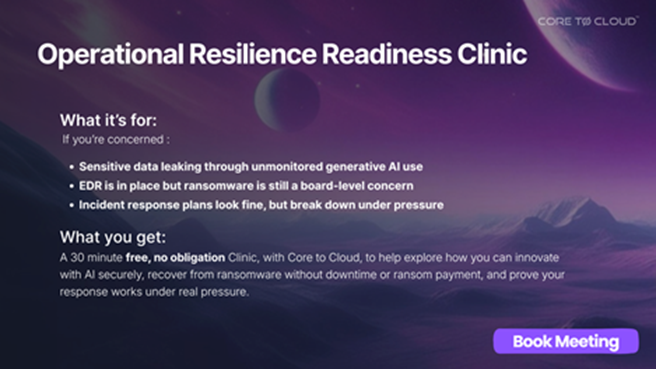
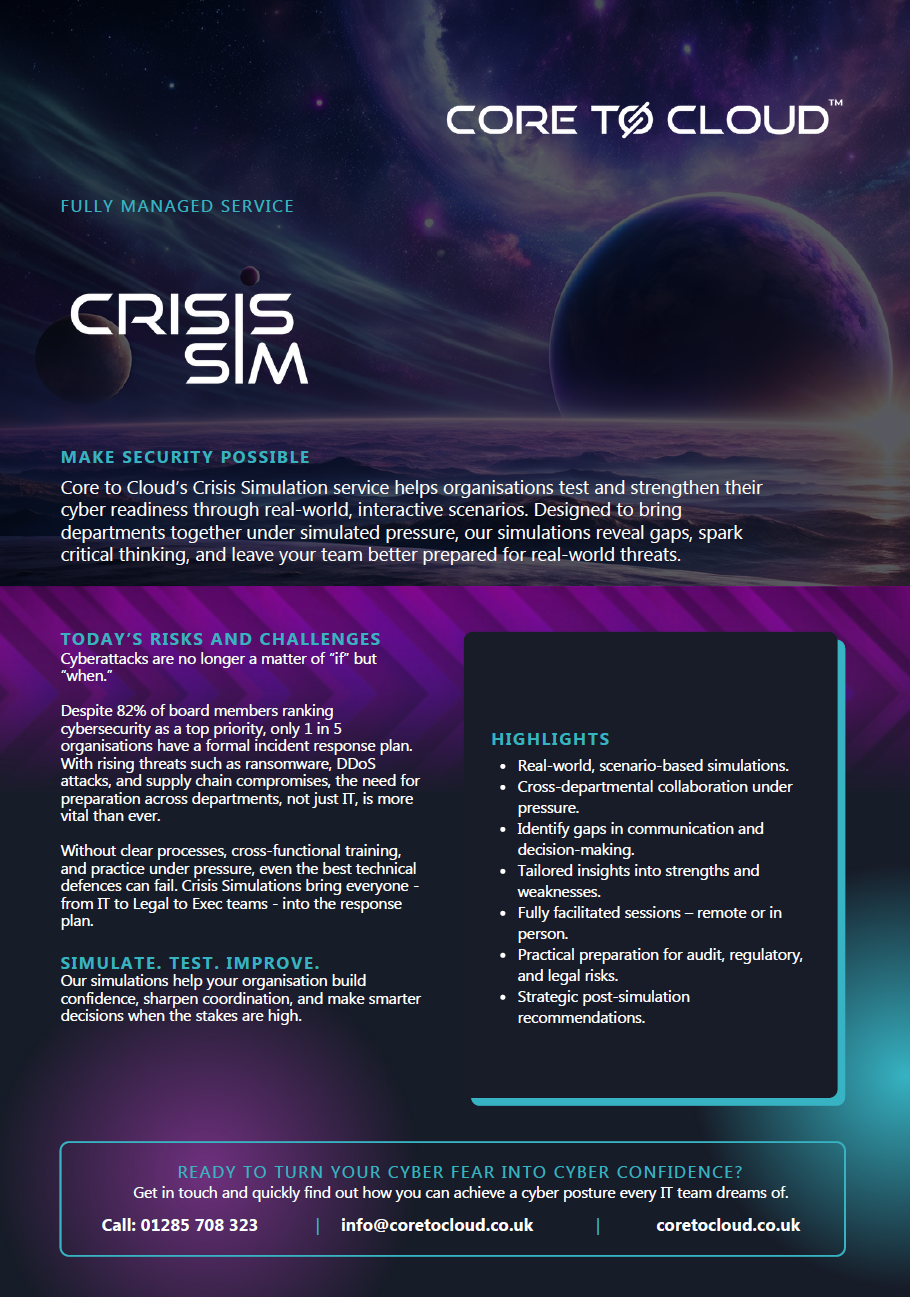
Core to Cloud’s Crisis Simulation service helps organisations test and strengthen their cyber readiness through real-world, interactive scenarios.
Designed to bring departments together under simulated pressure, our simulations reveal gaps, spark critical thinking, and leave your team better prepared for real-world threats.
This series is featured in our community because it reflects conversations increasingly happening among senior security and risk leaders.
Much of the industry focuses on tools and threats, with far less attention given to how confidence is formed, tested, and sustained under scrutiny. The perspective explored here addresses that gap without promoting solutions or prescribing action.
Core to Cloud is referenced because its work centres on operational reality rather than maturity claims. Their focus on decision-making, evidence, and validation aligns with the purpose of this publication: helping leaders ask better questions before pressure forces answers.
Let us know what you think about the article.