Stopping ransomware before it stops the business
Framing ransomware as a technical problem misses what makes it so damaging
Framing ransomware as a technical problem misses what makes it so damaging
Files encrypt, systems go offline, and IT teams work to restore access. That framing is understandable, but it misses what makes ransomware so damaging. The real impact is rarely limited to devices. When ransomware lands, it can interrupt the entire operation of a business and force high-pressure decisions that involve leadership, customers, suppliers, insurers, and sometimes regulators. By the time the disruption becomes visible, the organisation is often already dealing with a situation that affects revenue, reputation, and the ability to deliver even basic services.
The reason ransomware causes such severe disruption is that it targets dependence. Most organisations rely on a chain of connected systems that keep production moving and work flowing, from core applications and identity services through to order processing, logistics, customer records, and finance. When those systems are unavailable, the business does not simply slow down. In many cases it stops. Deliveries are delayed because teams cannot access schedules or stock systems. Customer service cannot see accounts or histories.
Finance cannot invoice or reconcile. Leaders are forced to decide how to keep operations running with incomplete information and limited options. The cost of downtime begins to accumulate immediately, and it rarely stays contained to a single day. Missed orders become cancelled contracts. Backlogs take weeks to clear. Confidence drops, and the disruption spills into areas that are difficult to quantify but very real, including customer churn and strained supplier relationships.
This is why ransomware is also a people problem. A serious incident creates intense working conditions across the organisation. Teams are pulled into long hours and urgent decisions, sometimes for days at a time. There is stress, fatigue, and the kind of operational disruption that affects morale and retention. In the worst cases, where the financial impact is significant, ransomware can contribute to restructuring and job losses. Even when it does not, the incident often leaves a lasting mark on how the organisation views risk, continuity, and resilience.
For boards, investors, and senior leadership teams, ransomware becomes a governance issue as quickly as it becomes a technical one.
For boards, investors, and senior leadership teams, ransomware becomes a governance issue as quickly as it becomes a technical one. If an organisation is listed or backed by investors, the conversation can shift rapidly to continuity, public messaging, legal exposure, and the integrity of business reporting. Even privately held organisations experience similar pressure from lenders, key partners, and major customers, especially when disruption affects service delivery. At that level, ransomware is not just an incident to resolve. It is a business event that can change the organisation’s trajectory.
It is also important to understand that encryption is often the final act, not the first. Modern ransomware operations are typically staged. Attackers try to get in quietly, escalate privileges, and position themselves to cause maximum disruption. Many organisations only realise they have a problem once files are encrypted and critical services are unavailable. Traditional security controls have often focused on known indicators and static patterns, but ransomware changes quickly and increasingly avoids obvious signatures. That is one reason why the first visible sign in a traditional environment can be encrypted files, at which point the damage is already well underway.
This reality has changed what effective ransomware protection needs to look like. Resilience cannot start at the moment of encryption. It has to operate earlier, focusing on behaviour and the conditions that enable ransomware to spread and complete its objectives. Halcyon is built specifically for that challenge. Instead of relying on static signatures alone, it monitors how processes behave and looks for ransomware-like activity such as rapid file modification patterns, unusual encryption routines, lateral movement attempts, and actions that suggest recovery is being undermined, including backup deletions and shadow copy manipulation. The intention is to detect those behaviours early and stop the activity before it becomes a business-wide outage.
When ransomware is detected, Halcyon is designed to interrupt the attack in real time. It can terminate the malicious encryption process before it completes and quarantine the infected device to prevent spread, while protecting backups from tampering. The effect is to reduce the window in which ransomware can cause widespread disruption, so the incident is contained while operations remain standing.
The intention is to detect those behaviours early and stop the activity before it becomes a business-wide outage.
Crucially, Halcyon is also designed around recovery, because the reality of ransomware is that even a strong defence needs a plan for when something slips through. Halcyon maintains a secure record of recent file states and uses that record to restore files when encryption is detected, while also reversing system changes that attackers commonly make to impede recovery. This approach is built to shorten recovery time dramatically, turning what can become days of disruption into a faster, more controlled restoration process.
That technology becomes more valuable when it is deployed as part of a clear operating model rather than treated as a standalone product. This is where Core to Cloud is deliberately different from a typical partner. Many organisations do not need another vendor relationship or another tool to manage. They need a partner who can translate ransomware resilience into operational outcomes, and who can make the technology fit the reality of the environment, the existing controls, and the pressures of audit and governance.
Core to Cloud works with clients to assess fit and scope before deployment, because ransomware resilience looks different depending on risk profile, operational dependence, and existing security maturity. That upfront work matters because it ensures Halcyon is placed where it will reduce business impact most, rather than being deployed generically. Core to Cloud then integrates Halcyon into the wider resilience picture, aligning it with existing endpoint tooling and SIEM workflows so that ransomware activity becomes visible, traceable, and auditable in the same way as the rest of the security programme.
When clients operate a SOC or use a managed detection and response service, Core to Cloud also connects the technology to real response ownership. When Halcyon triggers, the goal is not simply to produce an alert, but to drive action and shorten decision time.
That is how ransomware resilience becomes measurable, because the business outcome is fewer hours of downtime, less disruption, and a clearer narrative for leadership and insurers that the organisation is prepared and in control.
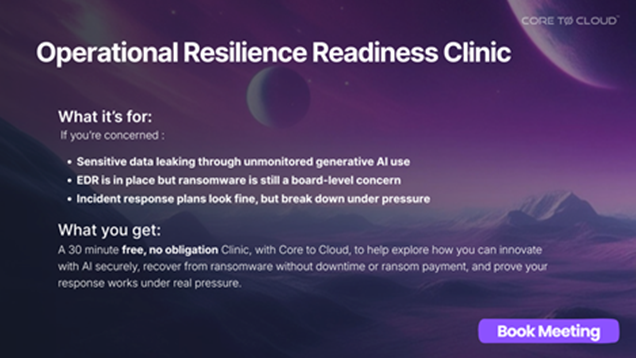
This series is featured in our community because it reflects conversations increasingly happening among senior security and risk leaders.
Much of the industry focuses on tools and threats, with far less attention given to how confidence is formed, tested, and sustained under scrutiny. The perspective explored here addresses that gap without promoting solutions or prescribing action.
Core to Cloud is referenced because its work centres on operational reality rather than maturity claims. Their focus on decision-making, evidence, and validation aligns with the purpose of this publication: helping leaders ask better questions before pressure forces answers.
Let us know what you think about the article.